How loud should white noise be for a baby? What the study found
White noise for a baby should be quiet: low enough that you can talk in a normal voice standing at the crib, and played from across the room, not in the crib. A useful reference point is the roughly 50 dB hospital-nursery limit used in a 2014 study published in Pediatrics. Every machine it tested went past that at full volume when placed close.
That's the short version. The rest of this post is the longer one: what the study measured, what it didn't, what the American Academy of Pediatrics actually says, and a few ways to check your own setup at 3 a.m. without buying anything.
What did the 2014 Pediatrics study find?
The study people usually mean is Hugh et al., "Infant Sleep Machines and Hazardous Sound Pressure Levels", published in Pediatrics in 2014 (volume 133, issue 4, pages 677–681).
The researchers took 14 infant sleep machines, turned each one up to maximum volume, and measured the sound at three distances: 30 cm (about 1 ft), 100 cm (about 3.3 ft) and 200 cm (about 6.6 ft). They compared the readings with 50 dBA, the hospital-nursery limit the study used as its benchmark. (dBA is decibels weighted toward how human ears hear.)
| Distance from the machine | What the study found at max volume | What it suggests for your room |
|---|---|---|
| 30 cm (about 1 ft), like a machine on the crib rail | All 14 machines exceeded 50 dBA. 3 exceeded 85 dBA. | Keep the machine or phone out of the crib and off the rail. |
| 100 cm (about 3.3 ft) | Also measured. The summary figures cited here are for the closest and farthest distances. | Closer than the study's farthest point, so volume matters even more. |
| 200 cm (about 6.6 ft), the longest distance tested | 13 of 14 machines still exceeded 50 dBA. | Distance helps, but at max volume it wasn't enough on its own. Turn it down too. |
Two details are worth holding onto. First, these were machines at maximum volume, which is not how most people run them. Second, the study measured how much sound the machines put out. It did not measure babies' hearing.
What the study's authors recommended
Based on those readings, the authors recommended placing sleep machines as far from the baby as possible, running them at low volume, and using them for a short time. They also recommended that manufacturers add output caps and auto-off timers. Children's Hospital of Philadelphia has a plain-language summary of the study if you'd like to read more.
The counterpoint
Not everyone agreed with all of it. Pediatrician Harvey Karp disputed the short-duration advice, and that same discussion points out that the study measured output, not hearing damage.
Both things can be true at once. The study shows how loud these machines can get, especially up close. It doesn't tell you what a given volume, at a given distance, for a given number of hours, does to a baby's hearing. Low volume and distance are the parts nobody argues with.
Does the AAP recommend a decibel level for white noise?
No. You'll see "the AAP recommends 50 dB" repeated online, but that's a mix-up. The 50 dBA figure is the hospital-nursery limit the 2014 study used as its benchmark. It isn't an AAP number for sleep machines at home.
Here's what the AAP has said. Its 2023 policy statement, Preventing Excessive Noise Exposure in Infants, Children, and Adolescents (published in Pediatrics in November 2023), says pediatricians can counsel parents on the safe use of infant sleep machines. It also says the 85 dB occupational limits used for adults at work shouldn't be assumed safe for children. It gives no decibel number for sleep machines.
Separately, the AAP's noise target for neonatal intensive care units is 45 dBA. That's a hospital setting, not a rule for your nursery, but it shows the kind of quiet hospitals aim for around the smallest babies.
Is white noise safe for babies?
We can't answer that with a yes, and you should be wary of anyone who does. The research above is about how loud machines can get, not about a proven safe level for home use. What the evidence does support is simple: the quieter and farther away the sound is, the less exposure your baby gets.
If you use white noise for infant sleep, the two levers you control are volume and distance. Keep both on the cautious side, and bring it up at your next pediatrician visit. The AAP statement specifically says that's a conversation pediatricians can have with you, and your pediatrician knows your baby.
How far should a white noise machine be from the crib?
As far as your room reasonably allows. The longest distance in the 2014 study was 200 cm, a little under 7 ft, and even there most machines at max volume were above the 50 dBA benchmark. So treat distance as one half of the answer and low volume as the other.
In practice:
- Put the machine or phone across the room on a dresser, shelf or table, not in the crib, on the rail or tucked by the mattress.
- If the speaker faces one direction, point it away from the crib or toward a wall.
- If the room is small, lean harder on volume. Turn it down until the by-ear check below passes.
- Keep any power cord well out of reach of the crib.
Sleepy Noise shows this same placement tip, at least 2 m from the crib, when its safer volume limit is on.
How do you check white noise volume at the crib?
You don't need special equipment for a rough check. Do it once when you set things up, and again any time you change the sound, the device or where it sits.
Check by ear
Turn the sound on at the volume you plan to use. Stand at the crib with your head about where the baby's head will be. Talk to someone across the crib in your normal voice.
If you have to raise your voice to be heard over it, it's too loud. Turn it down until normal conversation is easy. A good habit is to start at the lowest setting and turn it up only until it covers the noise you're trying to mask, like a hallway light switch, a barking dog or an older sibling's bath time.
Check with a phone sound meter app
Free sound meter apps can give you a rough reading. Set the phone where the baby's head will be, let the white noise run, and look at the number.
Know the limits before you trust it. Phones aren't calibrated sound meters. Microphones and software differ from phone to phone, so the number on the screen isn't a precise decibel reading. Use it to compare, not to certify: is tonight louder than last night, does moving the speaker across the room lower the reading. If it reads well above 50, that's a clear sign to turn it down or move it farther away. If it reads below, that's encouraging, not proof.
Using a phone as a white noise machine for a newborn
A phone works fine as a sound source if you set it up like a machine and leave it alone. This checklist applies to any white noise app you use for a newborn.
- Not under the mattress, not in the crib. It muffles the sound and puts a device and a cord where the baby sleeps.
- Across the room, on a stable surface. Same distance rules as a machine.
- Charge it away from the crib. Plug it in across the room so the cord can't reach the crib.
- Silence it. Turn on Do Not Disturb so texts and alerts don't chime. Airplane mode is optional. It also stops calls, which is fine on a spare phone but maybe not on the one you need to reach you.
- Set the volume once. Do the by-ear check, then leave the phone's volume where it is.
- Use an app, not a browser tab. Our free in-browser white noise player is handy for trying sounds, but phone browsers usually stop audio when the screen locks. Sleepy Noise runs in the background and works offline, so it keeps playing with the screen off or in airplane mode.
If you're deciding between a dedicated machine and a phone, we compared them in white noise machine vs. phone app. For the bigger picture on sounds and routines, see our guide to white noise for babies.
Where Sleepy Noise fits
We built Sleepy Noise after a lot of 3 a.m. nights with a baby, so the volume question shaped a few defaults.
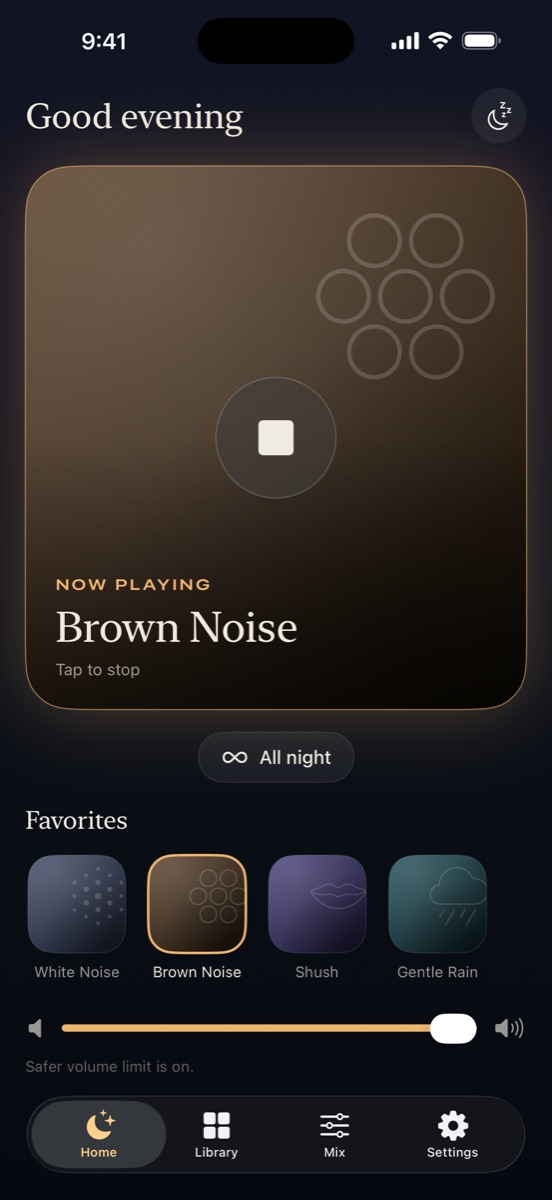
The safer volume limit is on by default. It caps the app's own volume at 60% and shows a tip to place the phone at least 2 m (about 7 ft) from the crib. It's a guardrail, not a guarantee. A phone can't measure decibels, so how loud 60% actually is in your room still depends on your phone's volume setting, its speaker, the distance and the room itself. Do the by-ear check anyway.
Every sound is loudness-matched, so switching from shushing to womb sounds won't suddenly jump in volume, and the app remembers your volume for each sound.
One honest difference from the 2014 study: Sleepy Noise plays all night by default, while the study's authors advised short use and auto-off timers. We made that choice because sound cutting out at 2 a.m. is its own problem, and Karp disputed the short-duration advice. If you'd rather follow the authors' approach, set a timer (15, 30, 60 minutes or longer) and it fades out instead of stopping abruptly. We wrote more about the tradeoffs in should white noise play all night. It's your call, and your pediatrician is the right person to talk it through with.
What it doesn't do: no cry detection, no sleep tracking. It plays sound, quietly, from across the room.
Frequently asked questions
Is 50 dB the AAP recommendation for white noise?
No. The roughly 50 dB figure is the hospital-nursery limit used as a benchmark in a 2014 study published in Pediatrics. The AAP's 2023 policy statement gives no decibel number for infant sleep machines.
Can I put a white noise machine in the crib?
Keep it out. In the 2014 study, all 14 machines exceeded 50 dBA at 30 cm at max volume, and 3 exceeded 85 dBA, so put the machine or phone across the room and keep the volume low.
What volume should my phone be at for baby white noise?
No phone percentage maps to a specific decibel level, because speakers and rooms differ. Start at the lowest setting, turn it up only until it covers household noise, and check that you can talk in a normal voice at the crib.
Should white noise play all night for a baby?
The 2014 study's authors advised short use and auto-off timers, and Harvey Karp disputed the short-duration advice. Low volume and distance matter either way; whether to use a timer is a good question for your pediatrician.
Are phone decibel meter apps accurate?
Not precisely. Phones aren't calibrated sound meters, so treat the reading as a rough comparison between setups rather than an exact decibel number.