Which sound to try first
There's no single right sound. Newborns often settle to sounds like the ones they heard before birth: a shush, a slow heartbeat or womb sounds. When a baby is crying hard, a louder, brighter sound like the vacuum or white noise can cut through, then you turn it down once they calm.
Older babies and toddlers often do well with something steady and low, like brown noise, a box fan or gentle rain. Give a new sound a few nights before you judge it.
How loud should white noise be for a baby?
Quieter than you'd think. A 2014 study in Pediatrics tested 14 infant sleep machines at full volume and found every one was louder than the roughly 50 dB limit used for hospital nurseries when measured 30 cm away, and 13 of 14 still were at 2 m. The authors advised low volume, as much distance as possible and limited run time.
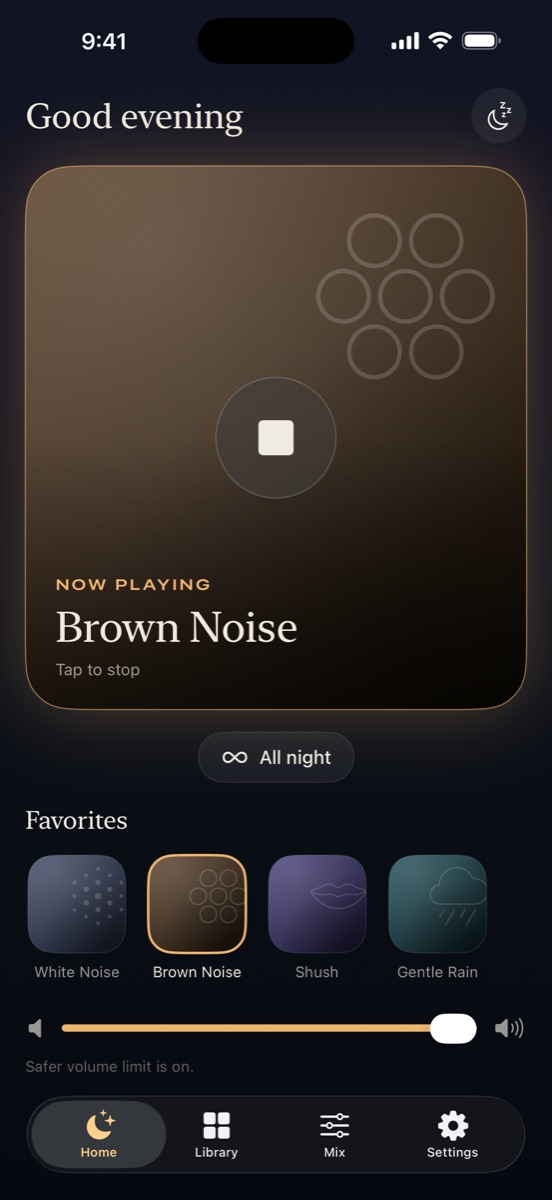
A practical check: stand by the crib. If you'd have to raise your voice to talk over the sound, it's too loud. Sleepy Noise has a safer volume limit that's on by default and caps the app at 60%. Phones can't measure decibels, so treat that as a guide, not a guarantee. The full picture, including what the AAP does and doesn't say, is in how loud white noise should be for a baby.
Where to put the phone
About 2 m (7 ft) from the crib, pointed into the room, never in the crib or under the mattress. Charge it away from the crib too. Turning on Do Not Disturb keeps a text from lighting up the room at 2 a.m.; Sleepy Noise keeps playing either way.
Many parents use an old phone as a dedicated sound machine. It's a good use for one: no new hardware, and your own phone stays with you. We compared the options in white noise machine vs. phone app.
All night, or a timer?
Sound that stops mid-night is a change, and changes are what wake people. That's why Sleepy Noise plays all night unless you set a timer. The 2014 study's authors suggested limiting run time, though, and some parents prefer a timer for naps or the first stretch of the night. It's your call; ask your pediatrician if you're unsure. We laid out both sides in should white noise play all night?
Made for the 3 a.m. moment
Sleepy Noise opens straight to one big button that plays My Sound, so you can start it with a baby in your other arm. You can also start it from a widget, the lock screen, Control Center, the Action Button or Siri, without unlocking and hunting. There are no ads, no ratings prompts and no upsells while a sound plays, and it won't start on its own when your phone connects to the car.
Frequently asked questions
Is white noise safe for babies?
Volume and distance matter most. Keep the sound low, the phone or machine across the room and out of the crib, and ask your pediatrician if you have concerns. Sleepy Noise's safer volume limit helps, but phones can't measure decibels.
What is the best white noise for a newborn?
Many parents start with shush, womb or heartbeat sounds, then move to white, pink or brown noise. Every baby is different, so try a sound for a few nights before switching.
Can white noise help with colic?
White noise can't treat colic, but plenty of parents find a loud shush or vacuum sound helps them through a crying spell. Turn it down once your baby settles, and talk to your pediatrician about colic.
How far should white noise be from a crib?
As far as practical. About 2 m (7 ft) was the farthest distance tested in the 2014 Pediatrics study, and most machines were still louder than a hospital-nursery limit there at full volume, so distance plus low volume is the combination to aim for.
When should I stop using white noise?
There's no set age. Many families use it for years. If you want to stop, lower the volume a little each night over a week or two, or switch to a softer sound, rather than going silent all at once.