Should white noise play all night? For babies and adults
For most people, yes: white noise works best when it plays all night, because it only masks sounds while it's on, and a sound that stops at 2 a.m. is itself a change that can wake someone. For babies, volume and distance matter more than duration. Keep it low, keep it across the room, and treat all night versus a timer as your call.
That's the short answer. The longer one involves a study from 2014, a pediatrician who disagreed with it, and some practical habits that matter more than the on/off question.
Why does continuous white noise matter?
White noise doesn't do anything to you. It covers other sounds. A truck, a dog, a door closing down the hall: those are sudden changes against a quiet background, and sudden changes are what tend to pull a light sleeper out of sleep. Steady noise raises the background, so the same truck becomes a smaller change.
That only works while the noise is playing. If it shuts off after 45 minutes, the rest of the night is back to an unmasked room. And the moment it stops is a change of its own. A room that goes from a steady hum to silence is a different room, and some people (and plenty of babies) notice.
This is why "my white noise stopped at night" is such a common complaint about sleep apps and sound machines. Some reviews of Baby Shusher's physical device mention a 15–30 minute timer that shuts off abruptly (App Store listing). Some Alexa ambient sound skills play for one hour by default and need a "loop" request to keep going, though behavior varies by skill (Tom's Guide). We wrote a separate post on why white noise apps stop at night and how to prevent it.
Should white noise play all night for a baby?
This is where it gets more careful, because there's real research and real disagreement.
What the 2014 Pediatrics study found
In 2014, researchers tested 14 infant sleep machines at maximum volume and measured the output at 30, 100 and 200 cm (Hugh et al., Pediatrics 2014). All 14 were louder than 50 dBA at 30 cm. Three were louder than 85 dBA at 30 cm. Even at 200 cm, 13 of the 14 were still above 50 dBA.
That 50 dB figure is the hospital-nursery limit the study used as its comparison. It's often repeated online as an "AAP guideline," but it isn't one. The authors recommended placing machines as far from the baby as possible, at low volume, and for a short time. They also suggested manufacturers add output caps and auto-off timers.
Why not everyone agreed
Harvey Karp disputed the short-duration advice. His point was that the study measured how loud the machines could get at full volume, not hearing damage in babies (NEJM Journal Watch). Both points are fair. The study is about output, and output is something you control.
What the AAP actually says
The American Academy of Pediatrics published a policy statement in November 2023, "Preventing Excessive Noise Exposure in Infants, Children, and Adolescents" (AAP news release). It says pediatricians can counsel parents on safe use of infant sleep machines, and that the 85 dB limits used for workplace noise shouldn't be assumed safe for children. It does not give a decibel number for sound machines. (Separately, the AAP's noise target for NICUs is 45 dBA.)
A practical middle path
Put those together and you get a reasonable approach most parents can live with:
- Volume first. Use the lowest level that covers the household noise you're worried about. If you have to raise your voice to talk over it, it's too loud.
- Distance second. Put the speaker or phone across the room, not in or beside the crib. Distance helps, but the 2014 study found most machines at full volume were still above 50 dBA at 200 cm, which is why volume comes first.
- Duration third. All night or a timer is your decision. If your baby wakes when the sound stops, a timer may cause more wake-ups than it saves. If you'd rather follow the 2014 authors' advice, use a timer.
- Ask your pediatrician. The AAP statement points parents to them for exactly this question.
Our guides to white noise for babies and how loud white noise should be for a baby cover placement and volume in more detail.
All night vs a timer: how they compare
| Option | What happens | Works well when | Watch out for |
|---|---|---|---|
| All night | Sound plays until you stop it in the morning | Noise problems happen at any hour, or the sleeper wakes when sound stops | Volume and distance matter more, since exposure is longer |
| Long fade timer (2+ hours) | Plays through the first sleep cycles, then fades slowly | You want sound for falling asleep and early night, less after | Late-night noises (garbage trucks, early risers) aren't covered |
| Short timer (15–60 min) | Covers falling asleep only | The room is quiet once everyone's down | The sound stopping can be the thing that wakes someone |
Whatever you pick, a fade-out beats a hard stop. Dropping from steady noise to silence in one step is the most noticeable version of the change you're trying to avoid, which is why Sleepy Noise timers fade out rather than cut off.
Is it bad to sleep with white noise every night as an adult?
We can't point you to a study that answers this, and we won't pretend otherwise. What we can say is that lots of adults use steady noise every night for the same reason parents do: it covers a partner's snoring, traffic, or neighbors. Whether that suits you is a preference.
Two sensible habits apply to adults too. Keep the volume at the lowest level that does the job, and keep the phone or speaker a little distance from your head rather than on the pillow. If you notice ringing in your ears or have hearing concerns, that's a question for a doctor, not an app.
If white noise feels too sharp for a full night, a softer color may be easier to live with. Our comparison of white, pink and brown noise explains the differences, and many adults end up on brown noise because it has no hiss.
Can you get dependent on white noise?
You can get used to it, the same way you get used to a particular pillow. Some people sleep fine without it on a quiet night and only notice its absence in a noisy hotel. Others find a silent room strange after months of steady sound. Neither is a problem unless it's a problem for you.
How to wean a baby (or yourself) off white noise
If you decide to stop, going gradually tends to be easier than going cold.
- Lower the volume over one to two weeks. Drop it a little every couple of nights. A small step is easier to adjust to than a big one.
- Swap to a softer sound. Moving from white noise to pink or brown, or to gentle rain, makes the sound less prominent before it goes away.
- Use a long fade timer. Instead of all night, let it fade out after a few hours. Then shorten the timer over the following nights.
- Pick a calm stretch. Skip the week of a move, a new tooth, or travel.
There's no right schedule here. Watch how sleep goes and slow down if it gets rocky.
Keeping the sound consistent when you travel
Hotels, grandparents' houses and campsites all sound different from home. The same sound at roughly the same volume is one of the few things you can bring with you. A phone app works anywhere, as long as it doesn't need Wi-Fi and doesn't stop when the screen locks. Sleepy Noise works offline and remembers the volume you set for each sound, so the travel version matches the home version.
Where Sleepy Noise fits
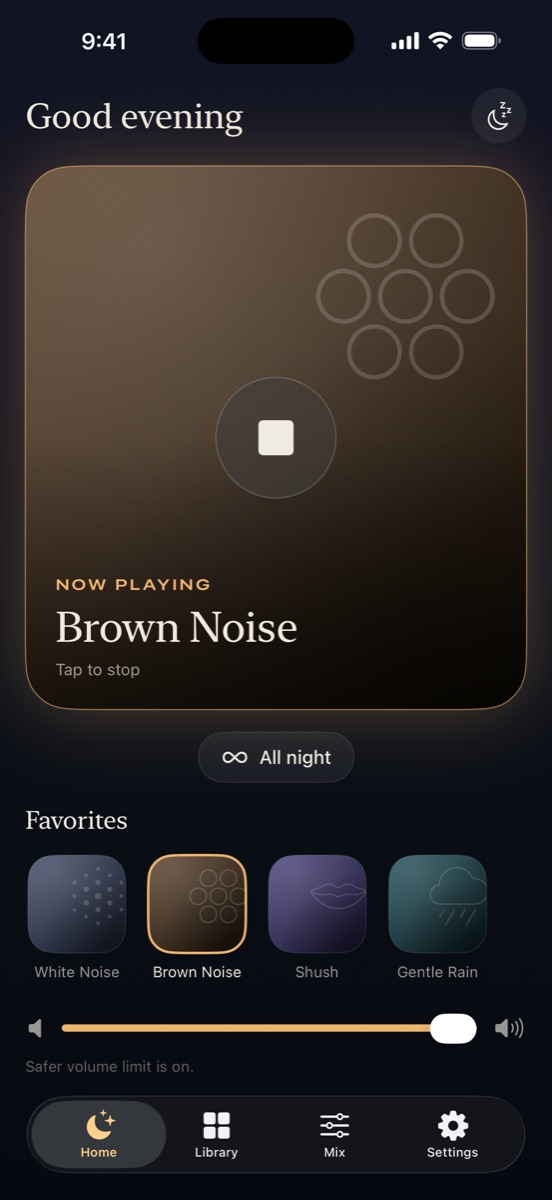
Sleepy Noise plays all night by default. It never stops on its own unless you set a timer. You can pick 15, 30 or 60 minutes or longer. It keeps going through calls, alarms and Siri, fading back in afterward.
For babies, a safer volume limit is on by default. It caps the app's volume at 60% and suggests placing the phone at least 2 m (about 7 ft) from the crib. It's a safer setting, not a guarantee: phones can't measure absolute decibels without calibration, so your ears and your pediatrician are still the real check.
It's free to download, has no ads, needs no account, and doesn't collect data. It doesn't do cry detection or sleep tracking. It plays a steady sound for as long as you want it to, and it stops when you tell it to.
Frequently asked questions
Should I turn off white noise after my baby falls asleep?
You can, but some babies wake when the sound stops, since silence is a change in the room. Many parents keep it on low and across the room instead. If you're unsure, ask your pediatrician.
Is it OK to leave white noise on all night for a baby?
The AAP's 2023 policy statement doesn't give a decibel number for sound machines and leaves safe use to you and your pediatrician. The 2014 Pediatrics study authors advised low volume, distance and short duration, so whatever you choose, keep the volume low and the speaker away from the crib.
How do I wean my baby off white noise?
Go gradually over one to two weeks: lower the volume a bit every couple of nights, switch to a softer sound, and move from all night to a long fade timer that you shorten over time.
Why does my white noise app stop in the middle of the night?
Common causes are a sleep timer, ads, phone battery settings closing the app, or another app taking over audio. Choose an app that plays all night by default and keeps running in the background.
Can adults sleep with white noise every night?
Many adults do, mainly to cover snoring, traffic or neighbors. Keep the volume at the lowest level that works, and talk to a doctor if you have hearing concerns.