White noise vs brown noise vs pink noise for sleep, compared
White noise vs brown noise comes down to where the energy sits. White noise spreads it evenly across every frequency and sounds bright and hissy like TV static, while brown noise piles it into the low end and sounds like distant thunder, with pink noise in between. The best one for sleep is the one you can listen to for eight hours without noticing.
None of these colors is better in general. They cover different sounds, and people hear them differently. Below is what each one is, what it tends to mask, and a cheap way to test them on yourself.
What is the difference between white, pink and brown noise?
All three are random noise. The difference is the slope: how quickly the sound gets quieter as the pitch goes up. That slope is what your ear hears as "bright" or "dark." The definitions below come from the standard colors of noise reference.
White noise
White noise has equal power at every frequency. On a graph it's a flat line. Because there are far more high frequencies than low ones in the range we can hear, a flat spectrum sounds top-heavy to us: hiss, static, a radio between stations, air rushing out of a vent.
It's the sharpest of the three, which is exactly why some people like it. A bright, wide sound sits right on top of voices, a TV in the next room, or the clink of dishes.
You can play white noise in your browser to hear the baseline the other colors are measured against.
Pink noise
Pink noise has equal power per octave instead of per frequency. In practice that means it drops by 3 dB every time the pitch doubles. The hiss is still there, but it's softer and rounder. Most people describe it as steady rain on a roof or wind through trees.
If white noise feels harsh but you still want something with some air to it, pink is usually where people land. Try the pink noise player right after white and the difference is obvious within a few seconds.
Brown noise
Brown noise (also called red or Brownian noise) drops by 6 dB per octave, twice as steep as pink. Nearly all the energy is in the low end. It sounds like a waterfall heard from a distance, a strong wind, or the inside of an airplane cabin. The name has nothing to do with the color brown. It comes from Brownian motion, the random jitter of particles that the math describes.
Brown noise has had a moment online, and it makes sense: it's the least hissy of the three, so people who find white noise grating often find brown easy to ignore. Listen to the brown noise player with headphones off and the phone across the room, which is how you'd actually use it.
Grey noise
Grey noise is shaped so every frequency sounds equally loud to a human ear, rather than measuring equally on a meter. Our ears are less sensitive to very low and very high pitches, so grey noise boosts those ends to compensate. It sounds fuller than white and less muddy than brown. Few people search for it, but it's worth a listen if none of the other three feels quite right.
White vs pink vs brown noise: comparison table
| Color | How it sounds | Slope | Masks well | People who tend to prefer it | Try it |
|---|---|---|---|---|---|
| White | Bright hiss, static, vent air | Flat (equal power per Hz) | Voices, TV, higher-pitched sounds | Light sleepers in noisy apartments, people who like a crisp sound | White noise |
| Pink | Steady rain, wind in trees | −3 dB per octave | A mix of voices and household noise | People who find white too sharp | Pink noise |
| Brown | Deep rumble, distant waterfall | −6 dB per octave | Snoring, traffic rumble, footsteps upstairs | People sensitive to hiss, fans of a "heavy" sound | Brown noise |
| Grey | Full and even, neither hissy nor muddy | Shaped to equal loudness | A broad mix of sounds | People who want balance across the range | In the app (Deeper Nights pack) |
"Masks well" is a rule of thumb, not a guarantee. Noise covers sounds best when it shares their frequency range, so a low rumble needs low noise and a high voice needs higher noise.
What color noise is best for sleep?
Start with what's keeping you up, then adjust for how your ears react.
If you're masking snoring, traffic or rumble
Low sounds need low noise. A partner's snoring, trucks on a highway, an upstairs neighbor walking, the building's HVAC: these live in the bass, and white noise mostly sails over them. Brown noise puts its energy right where those sounds are. This is the most common answer to "what is brown noise good for."
If you're masking voices or high-pitched sounds
Conversation, a TV through the wall, a dog's bark, a beeping appliance: these sit higher. White or pink noise covers them better than brown, which can let a voice float over the top. Pink is the usual compromise if white is too much. That's the practical answer to "what is pink noise good for": it covers a wide range without the full hiss.
If hiss bothers you
Some people hear white noise and immediately think "static" or "TV left on." If that's you, skip straight to brown or grey. There's no reward for tolerating a sound you dislike, and a sound you dislike is a sound you'll keep noticing.
For babies
Many parents reach for white noise or a shush sound first. Brown and pink work too, and some parents prefer them simply because they're less sharp to adult ears in the same room. The color matters less than the volume and placement. A 2014 study in Pediatrics measured 14 infant sleep machines at maximum volume and found all 14 were louder than 50 dBA at 30 cm, and 3 were louder than 85 dBA at that distance (summary from CHOP). Keep it low and keep it away from the crib. Our guide to white noise for babies goes into placement in detail.
Is pink noise better for deep sleep?
You may have seen headlines about pink noise and deep sleep. The honest version: the research is early, and it mostly comes from lab setups where short bursts of pink noise were timed to a sleeper's slow brain waves using closed-loop equipment. That's a very different thing from playing pink noise from a phone all night. We don't make claims about deep sleep. Pick pink because you like how it sounds.
A simple 3-night test
Reading about noise colors only gets you so far. Your ears and your bedroom are the real test. Here's a method that takes three nights and costs nothing.
- Night one, brown. Same bedtime, same spot for the phone, a volume that covers the room's noise without feeling loud.
- Night two, pink. Everything else the same.
- Night three, white. Everything else the same.
Each morning, jot down two things: whether you noticed the sound while falling asleep, and whether anything woke you that the noise should have covered. You're not scoring sleep quality. You're looking for the color you stopped hearing.
Two tips make the test fairer:
- Match the loudness. A louder sound tends to win any quick comparison, because it covers more. If one color plays louder than another, the test is really about volume. Try to keep them at a similar perceived level.
- Don't switch mid-night. If you wake at 3 a.m. and change colors, you've learned nothing about either one.
Sleepy Noise loudness-matches every sound to the same level (−20 dBFS RMS), so you can switch from brown to pink to white without the volume jumping. It's not a perfect stand-in for how loud each one feels, since our ears hear bass and treble differently, but it gets you close and removes the biggest bias. Phones can't measure absolute decibels, so trust your ears over the slider position.
Can you mix noise colors?
Yes, and it often works better than any single color. A few combinations people like:
- Brown under rain. Brown handles the low rumble, and rain sounds add texture on top so it doesn't feel like a wall of static.
- Pink plus a fan. Pink gives even coverage, the fan adds a familiar mechanical hum.
- Brown plus a little white. A small amount of white on top of brown covers voices that brown alone lets through.
Keep the main layer loudest and the extras just audible. The goal is one blended sound, not three things competing for attention. In Sleepy Noise you can layer up to three sounds with a separate volume for each, and save one mix for free.
Where Sleepy Noise fits
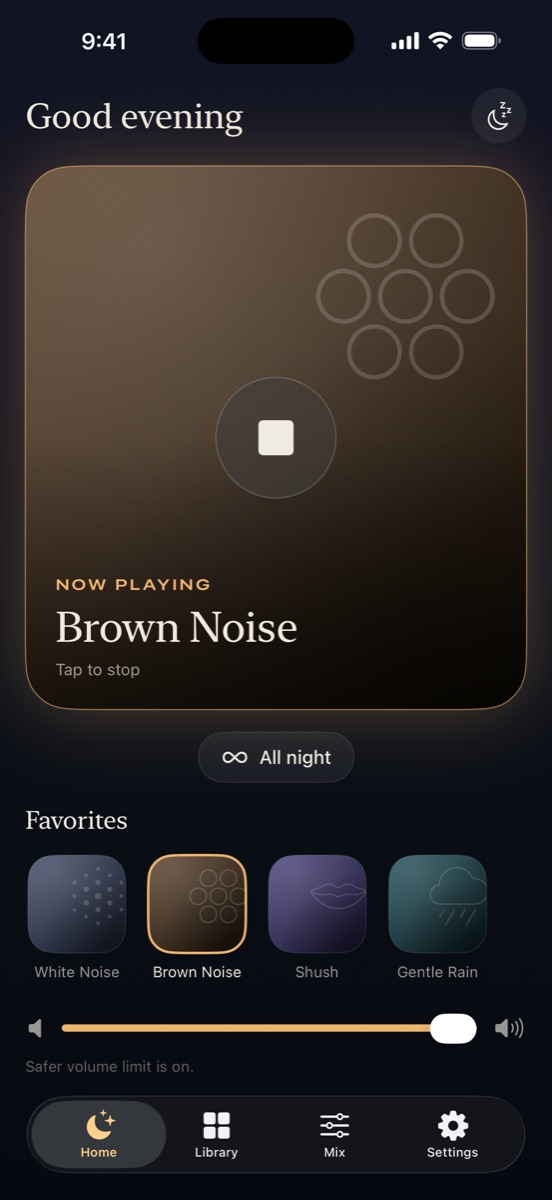
Sleepy Noise is a white noise app for iPhone and Android. White, pink and brown noise are in the free set of 12 core sounds, along with rain, ocean, fan and a few baby-focused sounds. The noise colors are generated live on the phone, so there's no loop point to notice at 2 a.m. It plays all night unless you set a timer, has no ads, needs no account, and works offline. If you end up wanting Grey Noise or Deep Brown, they're in the Deeper Nights pack, which comes with Sleepy Noise Lifetime, a one-time $9.99 purchase with no subscription.
What it doesn't do: no sleep tracking, no cry detection, no meditation library. It plays sound, and it keeps playing. If you're still deciding how long it should run, read should white noise play all night.
Frequently asked questions
Is brown noise or white noise better for sleep?
Neither is better for everyone. Brown noise covers low sounds like snoring and traffic and has no hiss, while white noise covers higher sounds like voices. Try each for a night at the same volume and keep the one you stop noticing.
What is the difference between pink noise and brown noise?
Both get quieter as pitch rises, but brown drops twice as fast: 6 dB per octave versus 3 dB for pink. Pink sounds like steady rain, brown sounds like a deeper rumble.
Why does white noise sound so harsh?
White noise has equal power at every frequency, and most of the frequencies we can hear are high ones. That gives it a bright, hissy character. Pink or brown noise tones down the highs.
Is grey noise the same as white noise?
No. White noise is flat on a meter, while grey noise is shaped so every frequency sounds equally loud to human ears. Grey sounds fuller and less sharp than white.
Does pink noise help deep sleep?
The research is early and mostly lab-based, using short bursts of pink noise timed to slow brain waves with special equipment. It doesn't show that playing pink noise all night from a phone does the same thing.