White noise for colic and what it can and can't do
White noise doesn't treat colic. What it can do is give a crying baby something steady to listen to while you hold, rock or walk them. The NHS lists gentle white noise among things to try, and the American Academy of Pediatrics suggests the sound of a fan, dryer, vacuum or white noise machine. Talk to your pediatrician first to rule out other causes.
We're a sound app, not doctors. Everything medical in this post comes from the NHS, the AAP's HealthyChildren.org and Nemours KidsHealth, linked below. Please read it as a parent-to-parent guide to the sound part, not as advice about your baby's health.
What is colic?
Colic is a lot of crying with no obvious cause in a baby who is otherwise healthy. The NHS describes it as crying more than 3 hours a day, 3 days a week, for at least 1 week. Nemours KidsHealth calls this the "rule of threes."
On timing, the AAP's HealthyChildren.org page on colic says:
- It usually starts between the second and fourth weeks.
- Fussing peaks at about 3 hours a day by 6 weeks, often between 6 p.m. and midnight.
- It generally stops by 3 to 4 months, though it can last until 6 months.
- About one-fifth of babies develop colic.
If you're in the middle of it, the end of that list is the part to hold onto. It does pass.
Does white noise help colic?
It can help some babies settle, and it's on the official lists of things to try. It won't stop colic, and no source we found says it does.
Here's what the sources actually say:
- The NHS suggests "gentle white noise like the radio or TV in the background to distract them," alongside holding, rocking, a warm bath and winding (burping) after feeds.
- HealthyChildren.org suggests running a vacuum in another room, or placing the baby where they can hear a clothes dryer, a fan or a white-noise machine. It adds that steady rhythmic motion and calming sounds may help a baby fall asleep, and warns never to place a child on top of a washer or dryer.
- KidsHealth doesn't mention white noise specifically but lists singing, talking, playing music, rocking, a stroller ride and a car ride in an infant car seat.
The pattern across all three is steady sound plus motion plus closeness. Sound is one tool in that set, not a fix on its own.
When should you call the doctor about crying?
Before you settle on "it's colic," HealthyChildren.org says to talk to your pediatrician to make sure the crying isn't caused by a medical problem, such as a hernia or an illness.
KidsHealth says to call right away if your baby:
- Has a fever of 100.4°F (38°C) or higher
- Is less alert or active than usual
- Isn't feeding well or isn't sucking strongly
- Has loose stools or blood in the stool
- Is throwing up with force
- Is losing weight or not gaining weight
- Can't calm down no matter what you do
The NHS adds two signs that call for emergency care: a weak or high-pitched cry, or a cry that doesn't sound like your baby's normal cry. It also says to get help if colic still hasn't eased after 4 months, if nothing seems to be working, or if you're finding it hard to cope. Trust your instincts. If something feels wrong, call.
How to use white noise during a colic episode
Think of it as two settings: one for a crying spell and one for sleep.
While the baby is crying
A soft sound under loud crying does nothing, because the baby can't hear it. During a crying spell many parents turn the sound up enough that they can hear it over the crying from where they're standing, then pair it with holding, rocking or walking. A rhythmic shush is the classic choice for this.
Keep the speaker away from the baby's ear. Hold the phone at arm's length or set it on a nearby surface, not against the baby's head or in the bassinet. And keep the louder setting short. It's for getting through the spell, not for the whole night.
Once the crying settles
As soon as the crying eases, bring the volume back down to your normal sleep level and move the sound source across the room. For sleep, quieter and farther away is the direction every source we've seen points. In a 2014 study published in Pediatrics, every infant sleep machine tested went past the roughly 50 dB hospital-nursery limit at full volume when placed 30 cm away. We went through the details in how loud white noise should be for a baby.
A quick check: stand at the crib and talk to someone in a normal voice. If you have to raise it, the sound is too loud for sleep.
Pair it with motion
Sound on its own often isn't enough with colic. HealthyChildren.org suggests walking the baby in a carrier or rocking them. The NHS suggests rocking in your arms, in the crib or Moses basket, or pushing them in the pram. KidsHealth adds a swing or vibrating seat, or a car ride in an infant car seat. Many parents find the sound works better alongside one of these than alone.
Which sounds do parents use for colic?
There's no "colic sound." These are the ones that line up with what the NHS and AAP suggest, and what parents tend to reach for.
| Sound | What it is | When parents tend to use it |
|---|---|---|
| Shush | A rhythmic "shhh," like a parent shushing | During a crying spell, while holding or rocking |
| Vacuum | A steady vacuum motor | When a real vacuum in another room has worked before |
| Dryer | A tumbling clothes dryer | Instead of setting the baby near a real dryer |
| Womb | A low, muffled whoosh | Winding down after the crying eases |
| Heartbeat | A slow, steady heartbeat | Quieter moments and the start of sleep |
| White noise or a fan | Broad, steady hiss or airflow | All-purpose; also covers household noise |
If one doesn't work, try another the next night rather than switching every few seconds mid-cry. Some babies prefer the low ones; some only settle to the louder, brighter ones.
Swaddling and safe sleep while you soothe
HealthyChildren.org lists swaddling among colic soothing ideas: wrapping the baby in a large, thin blanket so they feel secure. If you swaddle, the AAP's swaddling guidance is specific:
- Always place a swaddled baby on their back to sleep.
- Stop swaddling as soon as your baby shows any signs of trying to roll over.
- Use hip-healthy swaddling that lets the legs bend up and out.
- Don't use weighted swaddles or weighted blankets.
HealthyChildren.org also suggests a tummy-down hold across your knees with a back rub while the baby is awake. If they fall asleep that way, move them to the crib on their back.
Take care of yourself too
Colic is exhausting, and the crying is hard to listen to for hours. HealthyChildren.org is blunt about one thing: no matter how frustrated you get, never shake a baby. It can cause blindness, brain damage or death.
If you feel yourself losing it, it's okay to stop. KidsHealth says to place the baby on their back in a crib with no loose blankets or stuffed animals, close the door and check on them in 10 minutes. Use the time to breathe, eat something or wash your face. Hand off to another adult whenever you can, even for an hour.
If you're worried you might hurt yourself or the baby, put the baby down in the crib and call for help. In the US, the Childhelp hotline is 1-800-422-4453. In the UK, the NHS lists the Cry-sis helpline, 0800 448 0737. And tell your own doctor if you're feeling depressed. That's part of looking after the baby, too.
Talk to your pediatrician
White noise is a soothing tool, not a treatment, and colic is a diagnosis your pediatrician should make. Bring up the crying at your next visit, or call sooner if you see any of the signs above. It's also a good place to ask about sound: how loud, how far away and for how long makes sense for your baby.
Where Sleepy Noise fits
We built Sleepy Noise after a lot of 3 a.m. nights with a baby, and a few things in it are made for that moment.
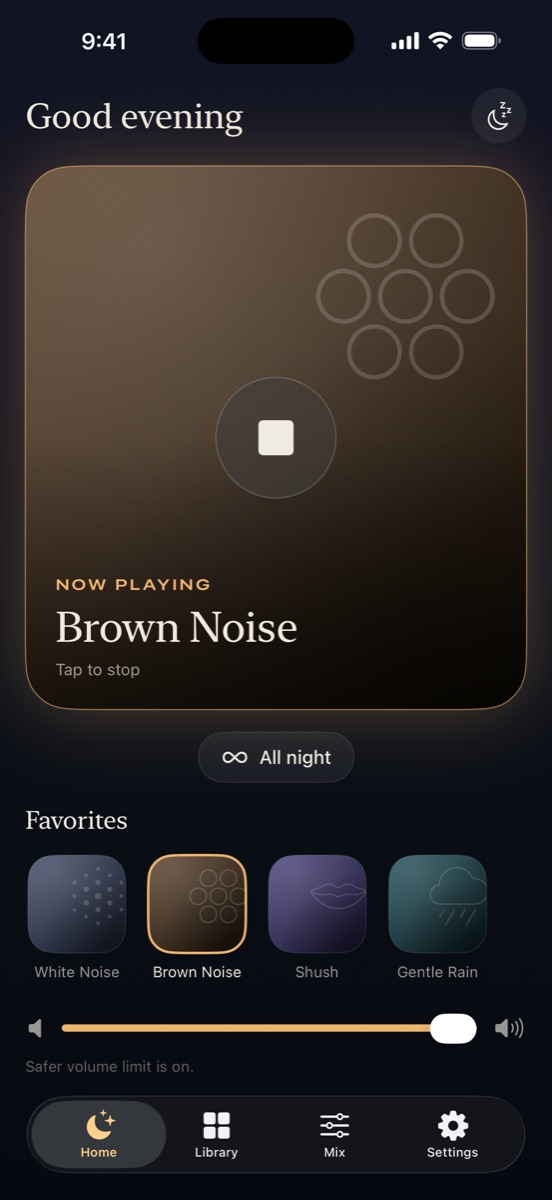
Shush, Vacuum, Dryer, Womb, Heartbeat and Car Ride are all among the 12 free core sounds, with no ads to cut in at the worst time. You can start your sound from a Lock Screen or Home Screen widget, Control Center or Siri without opening the app, which matters when both arms are full. Every sound is loudness-matched, so switching from shush to womb sounds won't jump in volume.
The safer volume limit is on by default. It caps the app's volume at 60% and shows a tip to place the phone at least 2 m (about 7 ft) from the crib. It's a guardrail, not a guarantee, since a phone can't measure decibels. If you want the sound to end after a crying spell, set a timer and it fades out instead of cutting off.
What it doesn't do: it has no cry detection and no sleep tracking, and it won't treat colic. It plays sound while you do the hard part.
Frequently asked questions
Does white noise help colic?
It doesn't treat colic, but the NHS and the AAP's HealthyChildren.org both list steady sound, like white noise, a fan, a dryer or a vacuum, among things to try. Many parents find it works best alongside holding and rocking.
What is the best sound for a colicky baby?
There isn't one best sound. A rhythmic shush is a common choice during crying, and vacuum, dryer, womb and heartbeat sounds are worth trying on different nights.
How loud should white noise be for a colicky baby?
During a crying spell, loud enough to hear over the crying, briefly, with the speaker away from the baby's ear. For sleep, turn it down until you can talk normally at the crib, and play it from across the room.
When does colic stop?
HealthyChildren.org says colic generally stops by 3 to 4 months but can last until 6 months. The NHS says to see a doctor if symptoms continue after 4 months.
Can I put my baby near a running dryer for colic?
Near it, with you there, is something HealthyChildren.org suggests, but never put a baby on top of a washer or dryer. A dryer sound played from across the room is an easier option.