How to sleep in a noisy apartment with thin walls and neighbors
To sleep in a noisy apartment, work in layers. Block what you can first with well-fitted earplugs and cheap fixes like a door sweep, heavy curtains and moving your bed off the shared wall. Then cover what's left with a steady sound matched to the noise: brown noise for footsteps and bass, pink or white noise for voices and TV.
Most apartment noise can't be fixed completely, especially as a renter. But you can usually get it from "keeps me awake" down to "I don't notice it," and that's the goal.
Why is apartment noise so hard to sleep through?
For reference, the World Health Organization's noise fact sheet gives less than 30 dB(A) in bedrooms at night as the level for good-quality sleep, and less than 40 dB(A) outside bedrooms as a yearly night average. The 40 dB figure is the target set in WHO's Night noise guidelines for Europe (2009). A city apartment with a busy street or a lively neighbor can be well above that.
Two things make apartments especially tricky.
The noise changes. A steady hum is easy to tune out. A door slam, a laugh through the wall or a motorcycle at 1 a.m. is not. What tends to wake people is the change, not the level.
Low sounds get through more. Walls and windows are better at stopping high-pitched sound than low rumble. An EU research summary on noise-absorbing windows puts it plainly: extra layers of glass absorb high frequencies but do little against low-frequency noise like aircraft or the bass of loud music. That's why you hear your neighbor's subwoofer and not their dialogue, and why upstairs footsteps arrive as thumps.
Keep both in mind. Blocking helps most with the higher sounds. Masking helps most with the changes.
Start with earplugs, and fit them properly
Earplugs are the cheapest and most direct fix, and most people put them in wrong. NIOSH, the CDC's workplace safety institute, teaches a three-step method for soft foam earplugs: roll, pull, hold.
- Roll the foam into a thin, tight cylinder between your fingers.
- Pull the top of your ear up and back with the opposite hand to straighten the ear canal.
- Hold the plug in place while the foam expands and seals.
If the plug sticks out of your ear or you can still hear the room clearly, take it out and try again. Foam, silicone and wax plugs fit differently, and comfort is personal, especially for side sleepers. Try a few kinds before deciding earplugs aren't for you.
Two cautions. Earplugs make it harder to hear a smoke alarm, a phone alarm or a child, so think about what you need to hear before you rely on them. And they block high sounds better than low ones, the same as walls, so bass and thumps can still come through. That's where sound helps.
Soundproofing basics a renter can do
None of these require a contractor or your landlord's permission.
Seal the gaps around the door
Sound travels through air, and a gap under a door is an open path. A stick-on or slide-on door sweep closes the gap at the bottom. Adhesive weatherstripping around the frame closes the sides. If your bedroom door faces a hallway or a living room where someone stays up late, this is often the single best cheap fix. A rolled towel along the bottom works for a night or two.
Hang heavy curtains
Thick, lined curtains that reach past the window frame on every side help with street noise, especially the higher sounds like voices and tires. They won't do much against a bus engine or bass. Get curtains wider than the window and hang them close to the wall so there's less gap at the edges.
Add soft things to the room
A rug, a padded headboard, a bookshelf full of books against the shared wall and fabric on hard surfaces all cut down on echo, which makes outside noise feel less sharp. Be realistic about rugs: a rug on your floor helps your downstairs neighbor, not you. It does nothing for footsteps coming from above.
Move the bed
This one is free. Look at where the noise comes from and put distance between it and your head.
- Pull the bed off any wall you share with a neighbor, even a few inches.
- If the street is the problem, put your head at the end of the bed farthest from the window.
- If the neighbor's TV is on the other side of your headboard wall, try the bed on a different wall entirely.
- If it's an option, sleep in the room farthest from the noise. Some people trade bedrooms with the living room for exactly this reason.
Talk to the neighbor or landlord
It's awkward, but people often don't know how much carries. A friendly note about the time a TV or speaker is bothering you, or a request to move a speaker off the shared wall, can fix more than any curtain. Check your lease too. Some include quiet hours or require rugs on upper floors.
Which noise color blocks which noise?
Once you've blocked what you can, a steady sound covers what's left. The rule of thumb: pick a sound with its energy where the problem noise lives. Brown noise is heavy in the low end (it drops 6 dB per octave, so it's mostly rumble). Pink noise is more balanced, like steady rain. White noise is bright and hissy, with the most high-end.
| Noise that keeps you up | Try first | Why | In Sleepy Noise |
|---|---|---|---|
| Upstairs footsteps, thumps, doors | Brown or deep brown noise | Low rumble sits where the thumps are | Brown noise, Deep Brown |
| Neighbor's bass or subwoofer | Deep brown noise, maybe with a fan | Covers the low end; the fan fills in the rest | Deep Brown plus Metal Fan |
| Voices and TV through the wall | Pink noise, then white | Speech sits in the middle and upper range | Pink noise, White Noise |
| Street traffic and buses | Brown noise or heavy rain | Engines rumble; rain adds texture that hides tire hiss | Brown Noise, Rain & Rolling Thunder |
| Sirens, horns, motorcycles | A fuller sound plus earplugs | Sharp sounds are hard to cover with sound alone | Pink noise or rain, with earplugs |
| Hallway chatter, elevator dings | Fan or pink noise | Steady broadband sound covers short, mid-range sounds | Box Fan, Metal Fan |
If one sound doesn't do it, layer two. Brown noise for the thumps plus a fan for the voices is a common pairing. We compared the colors in more detail in white noise vs pink noise vs brown noise.
What about upstairs neighbors specifically?
Footsteps are the hardest apartment noise to deal with because they come through the structure as low thumps, and walls, curtains and earplugs all do least against low sounds. Masking with deep brown noise is often the most practical option. Set it during the hour when the footsteps are worst so you're tuning against the real thing.
How loud should masking noise be?
As quiet as it can be while still covering the problem. Remember the WHO's 30 dB(A) figure for bedrooms at night: a masking sound adds noise to the room, so turning it way up to beat a party next door trades one loud sound for another.
A simple way to set it:
- Wait until the noise is happening, or at least the typical background of your street.
- Start the masking sound low and turn it up slowly.
- Stop at the point where the problem noise stops standing out. You may still hear it if you listen for it. That's fine.
Phones can't measure decibels accurately, so set it by ear. If you share the bedroom, set it with the other person in the room. Earplugs and masking together often work at a lower volume than either alone, since the plugs take the top off and the sound fills in what's left.
Should it run all night?
Apartment noise doesn't keep a schedule. The neighbor who comes home at 2 a.m. will do it after your 60-minute timer has ended. For that reason a lot of people in noisy buildings leave masking on until morning. We went through the tradeoffs in should white noise play all night.
Where Sleepy Noise fits
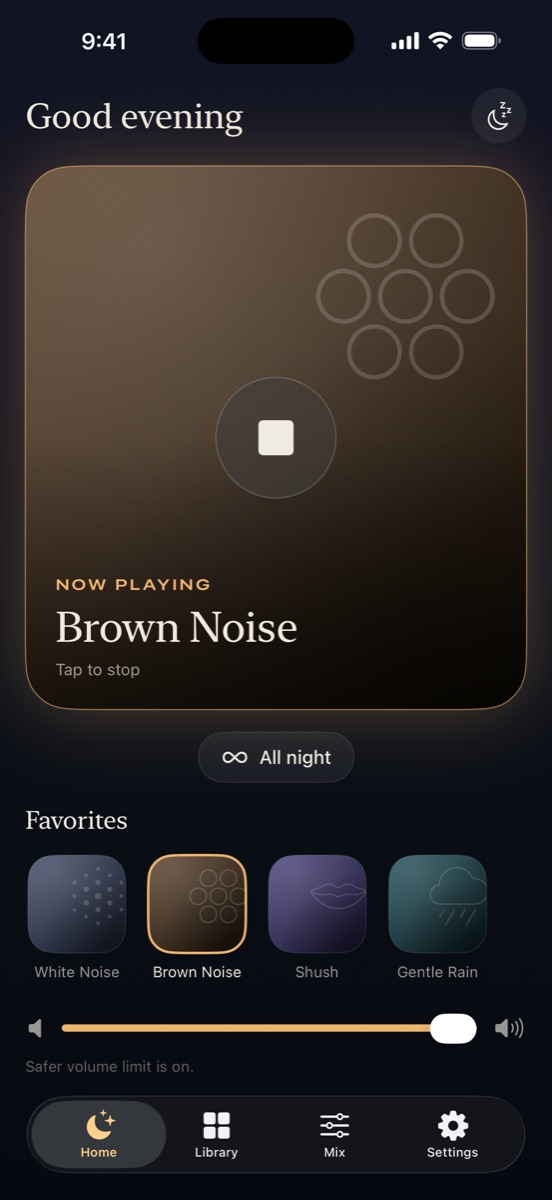
We built Sleepy Noise as a sound app that stays out of the way, and a few things in it are useful in a noisy building.
Brown, Pink and White Noise, Box Fan and Gentle Rain are among the 12 free core sounds. The heavier options in the table, Deep Brown, Metal Fan and Rain & Rolling Thunder, come with Sleepy Noise Lifetime, a one-time $9.99 purchase with no subscription. You can play previews of all of them on this site first.
It plays all night by default and keeps going through calls and alarms, then fades back in. Every sound is loudness-matched, so trying brown noise and then rain won't blast you when you switch. You can layer up to three sounds with separate volumes, and save one mix free, which is handy for a brown-plus-fan combination. It works offline and has no ads, so nothing will interrupt the sound at 3 a.m.
What it doesn't do: it can't stop your neighbor or measure how loud your room is. It plays steady sound so the noise around it stands out less.
Frequently asked questions
How do I block out noise from upstairs neighbors?
Footsteps come through the ceiling as low thumps, which earplugs and soundproofing handle poorly. Deep brown noise is usually the best masking choice, and moving your bed out from under the busiest part of their floor can help.
Does white noise block out neighbors?
It covers some of it. White noise works best on voices and higher sounds; for bass, thumps and footsteps, brown or deep brown noise is a better match.
What is the best noise to sleep with street traffic?
Brown noise or heavy rain. Traffic is mostly low engine rumble with some tire hiss on top, and brown noise covers the rumble while rain covers the hiss.
Can I use earplugs and white noise together?
Yes, and many people find the combination works at a lower volume than either one alone. Keep in mind that earplugs make alarms and other important sounds harder to hear.
How do I sleep with thin walls?
Pull your bed off the shared wall, seal the gap under your bedroom door, and run a steady sound at the lowest volume that covers what comes through. Pink noise suits voices and TV; brown noise suits bass.