Fan noise vs white noise for sleep, and which one to use
Fan noise isn't true white noise. White noise has equal power at every frequency and sounds like a bright hiss, while most fans sound lower and warmer, closer to brown noise, with a soft wobble from the blades and a faint motor hum. Both mask background noise. The better one for sleep is the one you can ignore, plus whether you want the breeze.
People use "white noise" loosely for any steady shushing sound, and a fan is the one many of us grew up with. Below is what actually makes a fan sound different, what a real fan does well and badly at night, and when a fan sound or plain white noise makes more sense.
Is fan noise white noise?
Not in the technical sense. White noise has a flat spectrum: the same power at every frequency, which our ears hear as top-heavy hiss, according to the standard colors of noise reference. A fan's sound is a mix of a few different things.
Rushing air
Most of what you hear is turbulence: air tumbling off the blades and through the grille. It's random and broadband like white noise, but in a household fan more of it lands in the low and middle frequencies. That's why a box fan sounds like a soft roar rather than static, and why it's closer to brown noise than to white noise.
The blade rhythm
Each time a blade passes a point, it gives the air a small push. Engineers call the resulting tone the blade pass frequency, and it's simply the number of blades times the rotation speed (Engineering Toolbox). Add a little unevenness in the airflow and you get the slow wobble most people associate with a fan. White noise has nothing like it.
The motor and the housing
Under the air there's usually a low hum from the motor. Older fans add a tick, a rattle in the grille or a slight whine as the bearings wear. Some people find those details comforting; others lie awake listening to them.
So the short answer to "is fan noise white noise" is no: it's a warmer, lower, slightly rhythmic broadband sound. That difference is exactly why many people prefer it.
What people mean by "white noise fan"
The phrase gets used for three different things, and it helps to know which one you're shopping for.
- A regular fan used for sound. A box fan, tower fan or ceiling fan running mostly for the noise.
- A fan-based sound machine. These have a real fan spinning inside a housing that shapes the sound. The Yogasleep Dohm Classic is the best-known one: the company describes it as a real fan motor with no digital audio, and it's listed at $49.99 on Yogasleep's site as of October 2026.
- A fan sound on a phone or speaker. Either a recording of a fan or a sound generated to behave like one, like our free box fan sound.
Real fan vs fan sound vs white noise
| Real fan | Fan sound (phone or speaker) | White noise | |
|---|---|---|---|
| How it sounds | Low roar, blade wobble, motor hum | Same character, depending on the recording or generator | Bright, even hiss |
| Moves air | Yes | No | No |
| Upfront cost | The price of a fan | Often free | Often free |
| Overnight running | Electricity for the motor | A phone or speaker | A phone or speaker |
| Upkeep | Dust on blades and grille, parts wear | None | None |
| In winter | Can leave you cold | No draft | No draft |
| Travel | Bulky, rarely packed | In your pocket | In your pocket |
| Volume control | A few fixed speeds | Fine-grained slider | Fine-grained slider |
| Sound over time | Changes as it ages | Stays the same | Stays the same |
| Covers best | Low and mid sounds | Low and mid sounds | Voices and higher sounds |
What a real fan does well
It cools you. This is the one thing no app can do. Fans don't lower the room temperature; they make you feel cooler with a wind chill effect (South Carolina Energy Office). On a hot night that's a real comfort, and the sound comes along for free.
It's simple. No phone, no settings. Flip a switch and it runs until morning.
It's familiar. Plenty of adults grew up sleeping next to a box fan and still can't sleep without one. A sound you've heard every night for years is a sound you don't notice.
The downsides of sleeping with a fan
It's cold in January. Because a fan cools you rather than the room, running one in winter just for the noise means sleeping in a draft. Pointing it at the wall helps a little.
It can dry your eyes. Air moving across your face all night can evaporate tears faster, especially with a fan aimed at you (Medical News Today). Angling it away or using a lower setting is the usual fix.
It collects dust. Blades and grilles gather dust, and a fan pushes air over them all night. If you run one every night, cleaning it every few weeks is part of the deal.
You get three volumes. Low, medium and high is coarse control. If low is too quiet to cover the street and medium is too loud for your partner, you're stuck.
The sound drifts. A new fan and the same fan two years later don't sound the same. When a rattle develops, the sound that used to put you to sleep becomes the one keeping you up.
It doesn't travel. Hotels, guest rooms and grandparents' houses rarely have the fan you're used to. That's often when fan sleepers start looking for a fan sound on their phone.
When a fan sound makes more sense
A fan sound gives you the character without the air. It's the better pick when:
- It's winter, or you want the noise but not the draft.
- You're away from home and want the same sound you sleep with every night.
- You need finer volume than three speeds.
- You share the room with someone who doesn't like the breeze.
- You want it in the nursery without a fan blowing near the crib. Keep it low and across the room; our guide to white noise for babies has placement details.
How it's made matters. A short recording on a loop can develop a pattern your ear learns to find. The Sleepy Noise box fan is generated live instead: airy noise with an irregular wobble, a low rumble and a 59 Hz motor hum, each changing on its own so the rhythm never repeats in a way you can track. If you want something heavier, loud fan noise is a recording of a big metal-blade fan on high, part of the Deeper Nights pack in Sleepy Noise Lifetime.
One honest limitation: a phone speaker can't reproduce the deepest rumble of a big fan in the room. If the sound feels thin, a small Bluetooth speaker across the room helps.
When white noise is the better choice
Fans are strongest in the low and middle range. If what keeps you up is higher pitched, white noise often covers it better:
- Voices through a wall or a TV in the next room
- A dog barking, a phone buzzing, dishes clinking
- Anything with sharp edges that pokes through a softer sound
White noise is also more uniform than a fan. If the wobble in a fan sound is something you notice and can't stop noticing, a flat hiss gives your ears nothing to follow. And if white feels too harsh, pink noise sits between the two. Our guide to white vs pink vs brown noise explains which color covers which sounds.
Fan or white noise machine for sleep?
A quick way to decide:
- Hot room, home every night, likes a breeze: a real fan does two jobs at once.
- Want the fan sound but not the air, or travel often: a fan sound on your phone, or a fan-based machine like the Dohm if you'd rather have a dedicated device.
- Masking voices or sharp sounds: white or pink noise.
- Masking snoring, traffic or footsteps: a fan sound or brown noise.
- Can't decide: try a fan sound one night and white noise the next, at a similar volume, and keep the one you stopped hearing.
You can also combine them. A real fan in summer and a fan sound in winter keeps the same bedtime sound all year. Or layer a little white noise over a fan sound to cover voices the fan lets through. Sleepy Noise mixes up to three sounds with a separate volume for each, so a box fan with a touch of white is easy to set up and save.
We wrote a separate comparison of white noise machines and phone apps if you're deciding between buying a device and using the phone you have.
Where Sleepy Noise fits
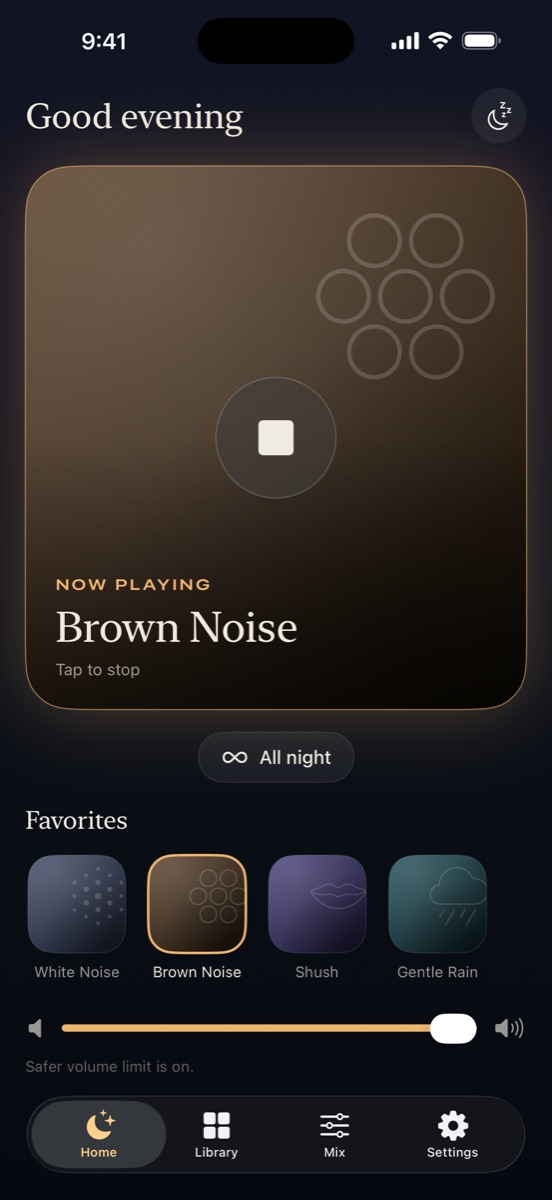
Sleepy Noise is a white noise app for iPhone and Android. Box Fan, white noise, pink noise and brown noise are all in the free set of 12 core sounds, along with rain, ocean and a few sounds for babies. It plays all night with the screen locked unless you set a timer, and timers fade out instead of cutting off. Every sound is loudness-matched, so switching from the fan to white noise doesn't jump in volume. No ads, no account, and it works offline. Metal Fan, the loud one, comes with Sleepy Noise Lifetime, a one-time $9.99 purchase.
What it can't do is move air. If you need the breeze, keep the fan.
Frequently asked questions
Is a fan considered white noise?
Loosely, yes, since both are steady broadband sounds that mask other noise. Technically no: a fan's sound is lower and has a rhythm from the blades, so it's closer to brown noise than to true white noise.
Is it better to sleep with a fan or white noise?
Neither is better for everyone. A fan covers low sounds and cools you, while white noise covers voices and higher sounds without a draft. Pick based on what you're masking and whether you want the air.
Why do I need a fan to sleep?
Usually habit and masking. If you've slept with a fan for years, its sound becomes part of how your room sounds at night, and silence can feel louder by comparison. A fan sound on your phone keeps that cue when the real fan isn't practical.
Can I get fan noise without the fan?
Yes. A fan sound on a phone or speaker gives you the same steady roar and blade wobble with no airflow, which helps in winter, when traveling, or when a partner doesn't want the breeze.
What is the difference between fan noise and brown noise?
Both are low and warm. Brown noise is perfectly steady random noise, while a fan adds a slow wobble from the blades and often a motor hum, so it sounds more like an object in the room.