How to sleep with a snoring partner, from earplugs to brown noise
To sleep with a snoring partner, stack a few small fixes rather than hunting for one. Fit foam earplugs properly, try to fall asleep before they do, help them sleep on their side, and cover what still gets through with steady, low-pitched sound like brown noise or a fan. If the snoring comes with pauses or gasps, it's worth a doctor visit.
Each layer takes the edge off. Together they usually turn "I can't sleep in here" into a room you can live with.
Why is a snoring partner so hard to sleep through?
Two things make snoring worse than its volume suggests.
It's low. A review of snoring acoustics in Sleep Medicine Reviews found the pitch of snoring sits in the low-frequency range, under 500 Hz, with harmonics above it (Pevernagie et al. 2010). Low sounds are the ones a bright white noise covers least well, so the most common fix often misses.
It's irregular. A snore comes, stops, comes back louder, pauses. Your brain notices change more than it notices level. In a small sleep lab study, recorded ICU noise pushed arousals from about 13 an hour to 48, but with steady white noise added underneath, arousals stayed near the normal level. The authors concluded that the jump from background to peak, not the peak itself, drove the wake-ups (Stanchina et al. 2005, Sleep Medicine). It was only four or five healthy adults, so treat it as a clue rather than proof, but it matches what most light sleepers already know.
And you're not alone. The same review estimates snoring affects 20 to 40% of the general population.
1. Wear earplugs the right way
Earplugs are the first thing the NHS suggests for a partner kept awake by snoring (NHS). Most people who say earplugs don't work never got a seal. NIOSH, which trains workers on hearing protection, teaches foam plugs as roll, pull, hold:
- Roll the plug into a thin, tight cylinder with clean fingers.
- Pull the top of your ear up and back with the other hand to straighten the canal.
- Hold the plug in with a fingertip while the foam expands.
Most of the foam should end up inside the canal. To check, cup your hands over your ears: if things get much quieter, the plug isn't sealing. Try again.
Earplugs tend to dull the higher part of a snore more than the deep rumble, so some of it can still come through. That's where the next layers come in. If you're a parent who needs to hear a baby, or you worry about missing an alarm, skip the plugs and lean on sound and timing instead.
2. Try to fall asleep first
Getting to sleep is often the hard part. If you can be asleep before the snoring starts, you may sleep through more of it. Go to bed 20 to 30 minutes earlier than your partner, or ask them to read in another room until you're out. It costs nothing and it's worth a week's trial.
3. Change the setup in the bed
Some of the biggest wins come from the snorer's side.
- Side sleeping. The NHS notes that people are more likely to snore on their back and suggests sleeping on your side, with tricks like sewing a tennis ball onto the back of nightwear or using a pillow or bed wedge.
- Alcohol and sleeping pills. The same NHS page suggests avoiding too much alcohol and notes sleeping pills can sometimes make snoring worse. A drink at dinner may be why Friday nights are louder.
- Separate covers. Two duvets on one bed mean fewer tug-of-war wake-ups, so the snoring has fewer chances to catch you between sleep cycles.
- More distance. A bigger bed, or turning to face away from your partner, puts their airway farther from your ear.
- Separate rooms some nights. Plenty of couples keep a spare bed for bad nights. It isn't a verdict on the relationship. Both of you sleeping is the point.
Talk about it in daylight, not at 2 a.m. "I love you and I need sleep" lands better before bed than after the third elbow.
4. Cover what's left with low, steady noise
This is where white noise for snoring often disappoints. Plain white noise spreads its energy evenly across frequencies, which to our ears sounds bright and hissy. Snoring lives low. A sound with more weight in the bass does more of the covering at a lower volume.
| Sound | What it sounds like | Why it suits snoring | Try it |
|---|---|---|---|
| Brown noise | Deep rumble, distant waterfall | Energy falls 6 dB per octave, so most of it sits low, where snoring is | Brown noise |
| Deep brown noise | Almost pure rumble, no hiss | Filtered steeply around 220 Hz, even lower than brown | Deep brown noise |
| Loud fan | Big metal fan on high | Broad, steady airflow with a fuller low end than a small fan | Loud fan noise |
| Heavy rain and thunder | Full rain with low, rolling thunder | Wide, constant rain, and the thunder adds weight in the low end | Heavy rain and thunder |
| White noise | Bright hiss, static | Better for voices and TV than for a low snore | White noise |
A few tips that make masking work better:
- Put the sound on your side of the bed, between you and the snorer, so it reaches your ears before the snore does.
- Expect phone speakers to be thin. Small speakers play deep sounds quieter than they really are. A small Bluetooth speaker, or soft sleep headphones if you sleep on your back, brings out brown noise properly.
- Try a mix. Brown noise plus a fan covers the low end and adds texture over the top. Keep one sound clearly louder than the other. The Sleepy Noise mixer layers up to three sounds with a volume for each.
- Give it a few nights. Most people stop noticing a steady sound within a night or two. The snore stands out less once your brain treats the noise as the room.
Our comparison of white, pink and brown noise goes deeper on which color covers which sounds.
5. How loud should the noise be?
Lower than you'd guess. You're not trying to drown the snoring out, only to blur its edges so the changes stop standing out. Start low, lie down, and raise it a notch at a time until the snore stops grabbing you. If you'd have to raise your voice to talk over it, it's too loud.
For a sense of scale, the WHO's safe listening guidance treats 80 dB for 40 hours a week as the adult limit, and you'll be listening for far longer than a workday, so err well below it. Phones can't measure decibels without calibration, so trust your ears over the slider. Keep the speaker off your pillow.
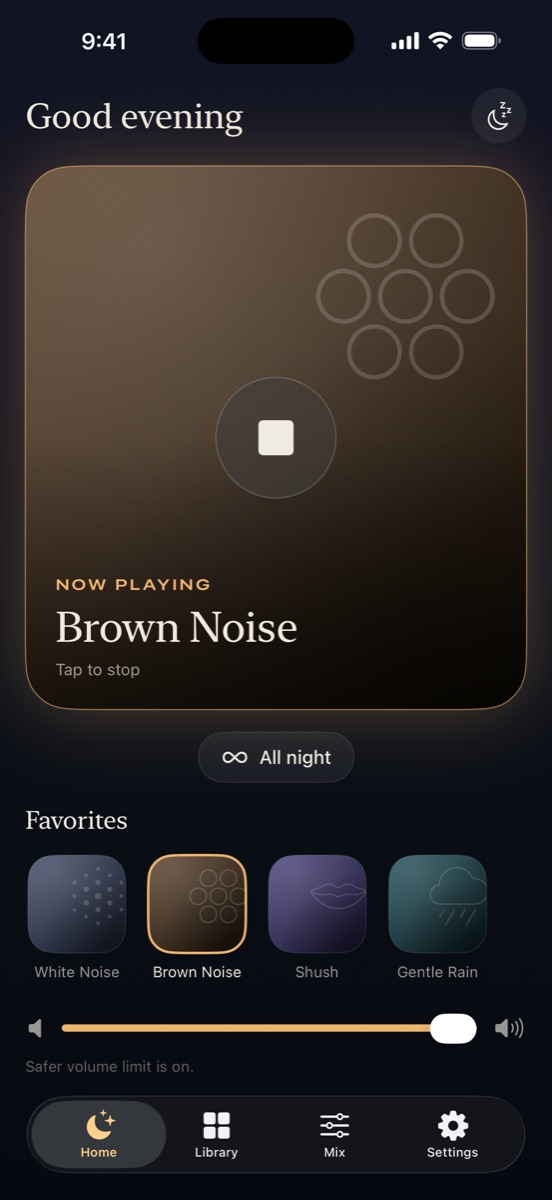
Let it play all night. A noise that cuts out at 2 a.m. leaves you lying in sudden quiet next to a snore, which is the exact change you were trying to avoid. Sleepy Noise never stops on its own unless you set a timer, for this reason. Our post on whether white noise should play all night covers the tradeoffs.
6. When is snoring a sign of sleep apnea?
Not every snorer has sleep apnea, but snoring is the most common warning sign, and a bed partner is usually the one who notices. The American Academy of Sleep Medicine calls out silent pauses in breathing followed by choking or gasping as a strong signal, along with daytime sleepiness, and urges people who snore to talk to a doctor.
The NHS suggests seeing a doctor if snoring is affecting your life or your partner's, if lifestyle changes haven't helped, or if there are signs of sleep apnea such as daytime sleepiness, pauses in breathing, or gasping or choking at night. It notes sleep apnea can be serious if untreated.
If you've lain awake listening to your partner stop breathing and restart with a gasp, tell them, kindly and in daylight. A doctor may order a sleep study. Masking noise helps you sleep through snoring; it does nothing for the person snoring, and it shouldn't stand in for that conversation.
Where Sleepy Noise fits
We make Sleepy Noise, so weigh this accordingly. Brown noise and Box Fan are among the 12 free sounds, generated live on the phone so there's no loop to catch your ear, and the app plays all night unless you set a timer. The mixer lets you layer up to three sounds, such as brown noise under a fan, and save one mix for free. Deep Brown, Metal Fan and Rain & Rolling Thunder come with Sleepy Noise Lifetime, a one-time $9.99. No ads, no account. It won't fix the snoring, and it isn't a substitute for a doctor if apnea is a possibility.
Frequently asked questions
Does white noise help with snoring?
It helps some, mostly with the higher parts of a snore. Because snoring sits low, under 500 Hz in one review, brown noise or a fan usually covers it at a lower volume than white noise does.
What is the best sound to block snoring?
A steady, low-pitched sound: brown noise, deep brown noise, a loud fan or heavy rain. Play it on your side of the bed, all night, just loud enough to blur the snore.
Can I use earplugs and white noise at the same time?
Yes, and they work well together. The plugs take the edge off the snore, and the noise fills in the low rumble that gets through. Keep the noise low, since the plugs already cut a lot.
How do I sleep next to someone who snores without earplugs?
Fall asleep first, put a low steady sound like brown noise between you and them, and help them sleep on their side. Separate covers and a little more distance in the bed help too.
Is loud snoring a sign of sleep apnea?
It can be. Snoring with pauses in breathing, gasping or choking, or daytime sleepiness are warning signs the AASM and NHS say are worth raising with a doctor.