Is brown noise good for sleep? What the research actually says
Brown noise can be good for sleep if you like how it sounds and need to cover low noises like snoring, traffic or footsteps upstairs. It isn't proven to improve sleep, though. A 2021 systematic review rated the evidence that steady noise helps sleep as very low, and most of that research tested white and pink noise, not brown.
Here's what brown noise does well, what the studies found, when it may not help, and how to set it up.
What is brown noise good for?
Brown noise (also called red or Brownian noise) is random noise whose power drops by 6 dB every time the pitch doubles, according to the standard colors of noise reference. Almost all of its energy sits in the low end. It sounds like a distant waterfall, heavy surf from inside a house, or wind outside an airplane window. You can listen to brown noise in your browser to hear it for yourself.
What people use it for at night comes down to three things.
Covering low sounds
A sound gets covered best by noise in the same frequency range. A partner's snoring, a truck idling outside, the neighbor's subwoofer, footsteps through the ceiling, an HVAC unit kicking on: these live in the bass. White noise spends most of its energy higher up, so low sounds can still come through it. Brown noise puts its energy right where those sounds are.
No hiss
White noise sounds bright and hissy, like a radio between stations, and some people can't stop hearing it. Brown noise drops most of the treble, so there's nothing sharp to latch onto. For a lot of people that's the whole appeal.
A sound that doesn't change
Rain, ocean and fan sounds have texture, and texture means variation. Brown noise is about as uniform as sound gets, which suits sleepers who notice every change in a sound.
Those are the real "brown noise benefits" for sleep: masking and comfort. They're practical, not medical.
What does the research say about noise and sleep?
Less than the internet suggests. There are three pieces of research worth knowing about.
The 2021 systematic review
A team including Mathias Basner of the University of Pennsylvania reviewed 38 studies on continuous noise as a sleep aid (Riedy et al., Sleep Medicine Reviews, 2021). The studies varied widely in the noise used, how sleep was measured and what they compared against, and their results ranged from noise improving sleep to noise disrupting it. Using the GRADE system for judging evidence, the authors rated the quality of evidence that continuous noise improves sleep as very low. They noted that this contrasts with how widely noise is used, and called for better studies with objective sleep measures and clear descriptions of the noise.
The 2022 review
A second review looked at 34 studies with 1,103 adults that used white noise, pink noise or a mix of sounds (Capezuti et al., Journal of Clinical Sleep Medicine, 2022). Nineteen reported better sleep outcomes: about a third of the white noise studies and most of the pink noise studies. The authors concluded the evidence doesn't strongly support sound as a sleep aid, and they found no adverse effects from short-term use. Brown noise isn't mentioned in the abstract.
The 2026 pink noise study
In February 2026, Basner's group at Penn published a lab study in Sleep (Penn Today summary). Twenty-five healthy adults aged 21 to 41 slept in the lab for seven nights with different conditions: quiet, aircraft noise, pink noise at 50 decibels, both together, and aircraft noise with earplugs. Pink noise alone was associated with nearly 19 fewer minutes of REM sleep. Earplugs largely prevented the deep-sleep loss caused by aircraft noise. The lead author, Mathias Basner, said the results "caution against the use of broadband noise, especially for newborns and toddlers" (Penn Almanac), and his team called for more research on the different noise colors.
Where that leaves brown noise
None of these studies tested brown noise on sleep, as far as their summaries show. Brown noise is a broadband noise like pink, with even more weight in the bass, so the same open questions apply: we don't know whether it helps, hurts or does nothing for sleep itself. The 2026 study was small, in a lab, at one volume, with one color. It's a reason to be careful, not a final answer.
We make a sound app, so take this from people with a stake in it: if you sleep well in a quiet room, you don't need brown noise. Where it earns its place is a room that isn't quiet.
Brown noise vs white noise for sleep
Neither is better in general. They cover different sounds and feel different to listen to.
| Brown noise | White noise | |
|---|---|---|
| How it sounds | Deep rumble, distant waterfall | Bright hiss, static |
| Where the energy is | Mostly low frequencies | Spread evenly, sounds top-heavy |
| Covers well | Snoring, traffic, footsteps, bass | Voices, TV, higher-pitched sounds |
| Hiss | Almost none | Plenty |
| Tends to suit | People who find white noise harsh | People masking voices, fans of a crisp sound |
| Research on sleep | None we could find on brown specifically | Some studies, very low quality overall |
| Listen | Brown noise | White noise |
If you're torn, pink noise sits between the two. Our full guide to white vs pink vs brown noise has a simple three-night test for picking one.
When brown noise may not help
Brown noise isn't the answer to every bad night. A few situations where it's the wrong tool:
- The noise you're fighting is high-pitched. Voices, a dog barking, a beeping smoke detector, a TV with dialogue: these sit above where brown noise is strongest. White or pink noise usually covers them better.
- Your room is already quiet. Adding sound to a quiet room means adding noise. Given the open questions in the research, there's no reason to play something you don't need.
- Earplugs would do the job. In the 2026 Penn study, earplugs protected sleep from aircraft noise better than pink noise did. If your partner snores or the street is loud and earplugs are comfortable for you, try them first or alongside.
- It's too loud. A loud masking sound is still a loud sound. If you need brown noise turned way up to cover a problem, the problem might be better handled another way.
- It sounds muddy to you. Some people hear brown noise as a pressure or a rumble in their head. If it bothers you after a night or two, switch colors rather than forcing it.
If you're thinking about brown noise for a baby, the Penn team's caution about newborns and toddlers is worth reading. Keep any sound low and the speaker well away from the crib, and ask your pediatrician if you're unsure. Our guide to white noise for babies covers volume and placement in detail.
How loud should brown noise be for sleep?
As quiet as it can be while still covering the sound that bothers you. A few practical rules:
- Set it in the real conditions. Adjust it at bedtime, with the phone where it'll sit all night, while the noise you're masking is happening.
- Start low and go up slowly. Stop where the snoring or traffic blends into the background. Less noticeable is the goal, not inaudible.
- Put the speaker across the room. Distance lowers the level at your ears and spreads the sound more evenly.
- Trust your ears, not the slider. Phones can't measure decibels without calibration, so there's no reliable number to aim for on a phone.
One trap with brown noise: our ears are less sensitive to low pitches, so it can be played louder than it feels. If you switch from white to brown and find yourself turning it up to "match," take a step back down.
Sleepy Noise loudness-matches every sound to the same level (−20 dBFS RMS), so switching from white to brown doesn't jump in volume and you can compare them fairly. It isn't a perfect stand-in for how loud each one feels, but it removes the biggest bias.
Should brown noise play all night?
That's a preference, and there's no study that settles it for adults. Steady sound tends to mask best when it keeps going: if it stops at 3 a.m., the next noise in the room is the one you'll hear. On the other hand, if you only need help falling asleep, a timer that fades out after 30 or 60 minutes means less sound overall. We cover the tradeoffs, including the research on infant sound machines, in should white noise play all night.
If you're using brown noise for focus during the day rather than for sleep, that's a different question with different research. See brown noise for ADHD.
Where Sleepy Noise fits
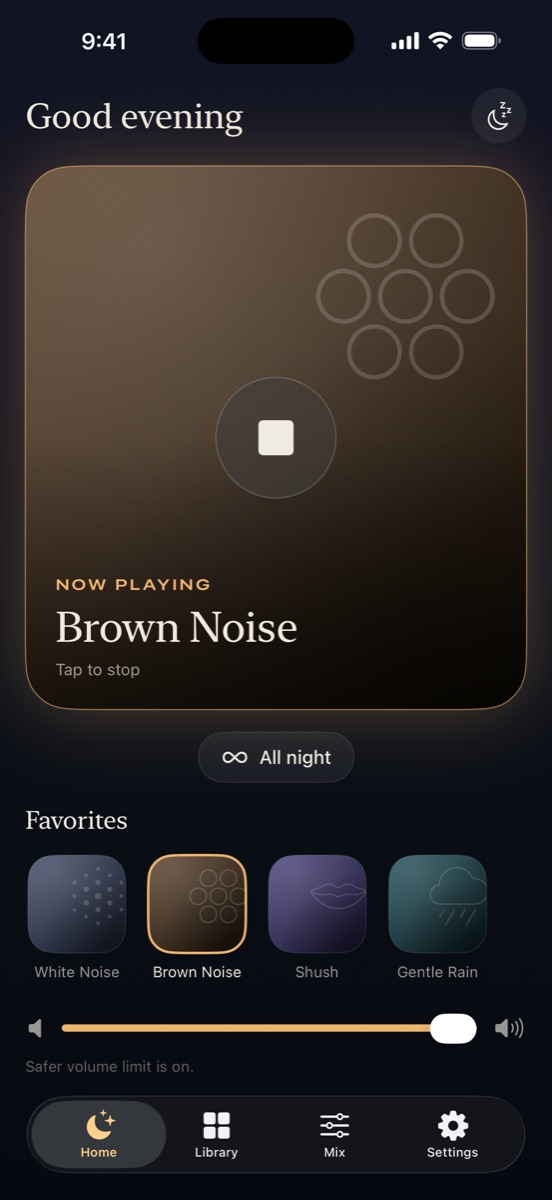
Sleepy Noise is a white noise app for iPhone and Android, and brown noise is one of its 12 free core sounds, along with white and pink noise, rain, ocean, a box fan and a few sounds for babies. The noise colors are generated live on the phone, so there's no loop point. It plays all night with the screen locked unless you set a timer, and timers fade out instead of cutting off. There are no ads and no account, and it works offline. If you want something lower still, Deep Brown is in the Deeper Nights pack, which comes with Sleepy Noise Lifetime, a one-time $9.99 purchase.
What it doesn't do: it doesn't track your sleep, and we don't claim it improves sleep. It plays a steady sound that covers the noise around you, at a volume you choose.
Frequently asked questions
Is it OK to sleep with brown noise every night?
Lots of people do, mostly to cover snoring, traffic or neighbors. The research on nightly noise is limited and mixed, so keep the volume as low as works, keep the speaker across the room, and skip it if your room is quiet enough without it.
Is brown noise better than white noise for sleep?
Neither is better for everyone. Brown noise covers low sounds and has no hiss, while white noise covers voices and other higher sounds. Try each for a night at a similar volume and keep the one you stop noticing.
Does brown noise help you fall asleep faster?
There's no good evidence either way for brown noise specifically. Reviews of white and pink noise studies found mixed results and rated the evidence low, so think of it as a way to mask distracting sounds rather than a sleep aid.
Can babies sleep with brown noise?
Many parents use brown noise because it's less sharp than white noise. The lead author of a 2026 Penn study cautioned against broadband noise for newborns and toddlers, so keep any sound low, place it well away from the crib, and ask your pediatrician.
What is deep brown noise?
Deep brown noise is brown noise with everything above a low rumble rolled off, so it sounds lower and darker, like an engine a few rooms away. People who find regular brown noise slightly hissy often prefer it.